Tag Archive for: being more organized

Stop Saying “Remind Me”

___

BONUS FREEBIE: Want even more ways to stay organized, productive and less stressed? CLICK HERE to get access to my List-Making Starter Kit. It will boost your efficiency and get you back to doing more of the things you love.

___

Have you ever had this happen? You ask someone for help or for a favor — and they say, “Sure, I’ll do that — just remind me.”

This is one of my biggest pet peeves. I know this doesn’t usually come from a bad place — it mostly comes from being overwhelmed, disorganized, or not having a system to manage your tasks.

Read more

In the Name of Productivity, Be Clear

___

BONUS FREEBIE: Want even more ways to stay organized, productive and less stressed? CLICK HERE to get access to my List-Making Starter Kit. It will boost your efficiency and get you back to doing more of the things you love.

___

I’ve realized over the years that we all have our own definitions of common terms like “EOD” and “ASAP.” And that can cause miscommunication and serious productivity hiccups! 

I was a TV producer for many years, so I have a specific definition of ASAP — to me it means “in the next few minutes.” Because when you’re on a deadline things move fast and you have to move quickly too. 

But… that’s not everyone’s definition of ASAP. For some people it means by the end of the morning, or by the end of the week, or just whenever they can get to it. If your job relies on communicating with lots of people from different industries, their definition (and yours!) will probably vary a lot. 

Productivity can be really hampered when we’re working with different assumptions. People can easily get frustrated when you’re not aligned on a timeline. Things go much more smoothly when there’s clarity in communication.

Here are some common productivity communication challenges and how to combat them:

1) ASAP

This is a big one — we all say it all the time, so it’s a hard habit to break. But it’s worth the effort. Instead of saying ASAP, it’s better to just share a specific day or time, even if it’s a range. And if someone says they’ll “get it done ASAP” but you don’t know when they mean, just ask politely if they can give more details about their timeline.

2) EOD

“End of day” seems like it would be straightforward enough. It can cause confusion when you don’t know someone’s work day! I once worked with someone whose workday ended at midnight and I didn’t realize it, so at 5 o’clock I was always left wondering what was going on. But she was thinking of her EOD, not mine! Since you never know when someone’s workday starts or ends, giving specific times is better.

3) Time zone

It’s super common now to work with people across different time zones. So it’s extra important to give time zone information when you’re scheduling meetings or deadlines. If you regularly work with someone in another time zone, it’s great if you can get in the habit of giving both your time zone and theirs (11am PST/2pm EST, for instance) when you’re communicating. That way there’s less room for error. I’ve been using an app to help with this – it’s called SavvyTime and you put in the time zones you need to know and it shows you all the times on screen. Very convenient! 

These all seem like small changes but they really add up! You might be surprised how much these communication pitfalls are impacting your productivity. 

___

BONUS FREEBIE: Want even more ways to stay organized, productive and less stressed? CLICK HERE to get access to my List-Making Starter Kit. It will boost your efficiency and get you back to doing more of the things you love.

___

Preparing for Conferences as an Attendee

__

BONUS FREEBIE: Want even more ways to stay organized, productive and less stressed? CLICK HERE to get access to my List-Making Starter Kit. It will boost your efficiency and get you back to doing more of the things you love.

___

Conferences are something I always look forward to. They provide networking opportunities, creativity-boosting experiences, and a chance to connect with like-minded professionals. But they can also be stressful or overwhelming without the right preparation. Showing up prepared makes all the difference.

Here’s a step-by-step guide to getting the most out of conferences:

Read more

Distraction Placeholders for Productivity

___

BONUS FREEBIE: Want even more ways to stay organized, productive and less stressed? CLICK HERE to get access to my List-Making Starter Kit. It will boost your efficiency and get you back to doing more of the things you love.

___

The average attention span is now about 47 seconds. Yep. That’s it!

That’s according to Dr. Gloria Marks — she’s a professor at the University of California and the author of the book “Attention Span”. It used to be much longer but with technology, it’s shrinking. And once you get distracted, it takes about 23 minutes to get back on track. That’s a lot of lost time!

But fear not — you don’t have to just accept that lost time. That’s where my distraction placeholder comes in. A distraction placeholder is a little note to your future self so that you can jump right back in after a pause.

Why use these? Well, you can’t always eliminate all distractions. It’s impossible to keep your focus at all times. Instead, focus on setting yourself up for success when a distraction pops up. 

I started doing this when I was a television producer and worked under very tight deadlines. I needed to focus on the work in front of me and couldn’t afford to lose my place. 

I’ve given lots of tips since my very first productivity blog went live in 2011. In all that time, the idea that I get the most positive feedback on again and again is the distraction placeholder. I’ve been using these for years and I’m so happy that this idea resonates with so many people.

___

___

Here’s how it works: 

Before I answer the phone or answer the door or whatever is interrupting me, I pause. I ask myself, “What am I in the middle of doing?” and then I write it down in my distraction placeholder spot on my to-do list. The bottom left hand corner of my to-do list is empty for this reason. I use that spot to jot down a quick note-to-self.

When I want to return to the work I was doing, I know exactly where I am. It helps to cut down on those 23 minutes it takes to get going again. 

The key is to give yourself the right information so that you can reduce the time it takes to re-enter a task. Because you might be losing more time than you think trying to get back in the flow. 

Ready to give it a try? Here are some guidelines:

  1. Be consistent. Use the same place to write down your distraction placeholder. And keep it handy. It’s not saving you time if you’re rooting around looking for your note!
  2. Keep it short and sweet. You don’t need to write more than a few words. The keywords will depend on what you’re doing, and you’ll see what works best for you as you use this tool. Bullet points often work best here.
  3. Be intentional about re-starting. Commit to getting back into the task fully. After the distraction is done, read over your placeholder note, take a moment to get back in the right headspace, and jump in. 

___

BONUS FREEBIE: Want even more ways to stay organized, productive and less stressed? CLICK HERE to get access to my List-Making Starter Kit. It will boost your efficiency and get you back to doing more of the things you love.

___

Secret Productivity Tool: Tarot Cards

___

BONUS FREEBIE: Want even more ways to stay organized, productive and less stressed? CLICK HERE to get access to my List-Making Starter Kit. It will boost your efficiency and get you back to doing more of the things you love.

___

I never get writer’s block.

It’s from years as a TV journalist, when I had to produce content on demand. Sometimes in a matter of minutes, we would have to put a whole show or segment together.

It’s ingrained in me to produce something, no matter what. I’m used to writing for a purpose, with a deadline in mind or an end game. I rarely, if ever, write “just because” or for “fun.” 

But… all that changed recently. And it’s all because of tarot cards.

Yep!

Let me tell you how, because it turns out that tarot cards can actually be an amazing productivity tool.

___
 

___


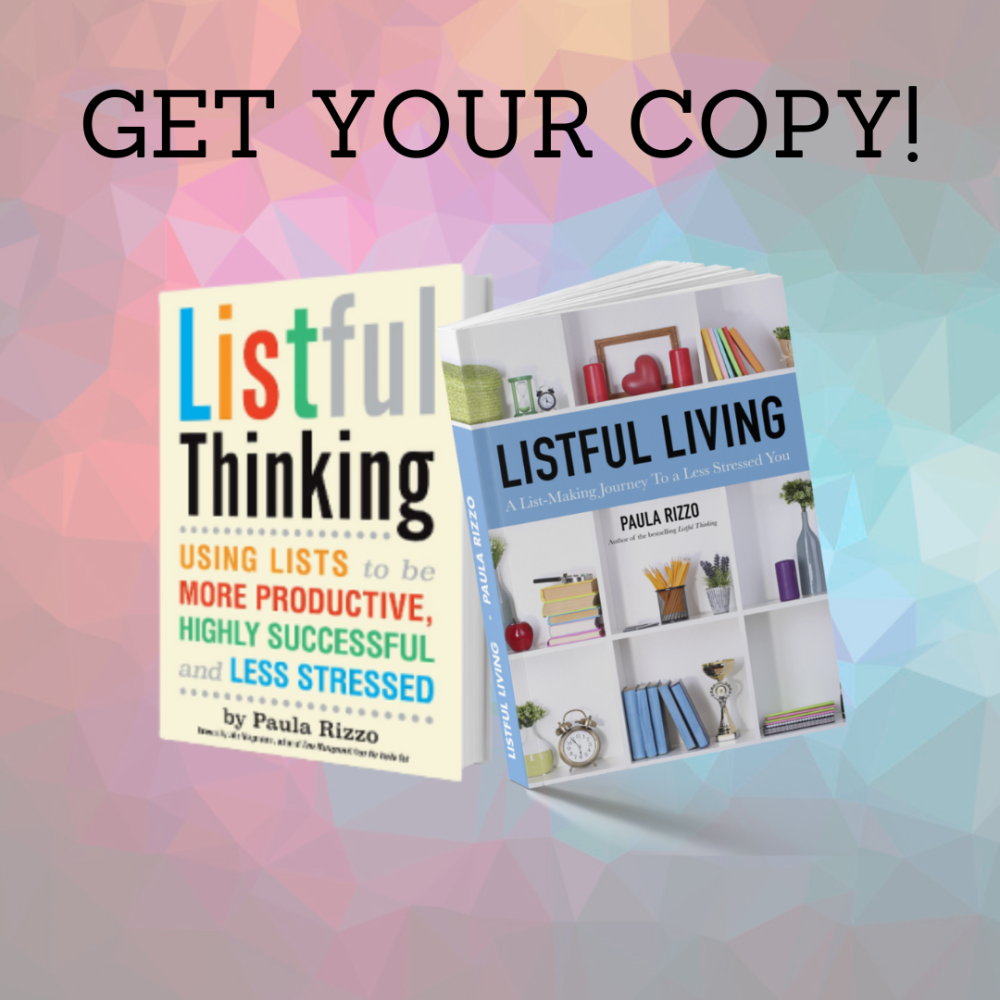
Every Friday, I set aside a chunk of time for writing. It’s a practice I started when I had to produce my second book, Listful Living, on a short deadline. Years later, I’m still doing it with my writing buddy Bev Sanders.

So during our regular Friday writing session, I decided to give writing for fun a try… But I was actually stumped on what to write about! Without an assignment or a prompt, it can be hard to get going.

But it turned out the answer was right in front of me. And that answer was (you guessed it!) tarot cards.

I recently started taking tarot card reading classes, and it’s an absolute delight. It’s strangely practical and surprising in the best ways. People think of tarot as witchy, but that’s actually a misconception. They have a long history and many different applications.

My tarot teacher, Kenneth James, Ph.D., is a Jungian analyst in private practice in Chicago, Illinois. He received a Ph.D. in Communicative Sciences and Disorders from Northwestern University, and a Diploma in Analytical Psychology from the C.G. Jung Institute of Chicago.

His approach is all about learning about yourself and using the cards for self-development and inspiration. And it turns out they’re a great tool for getting yourself unstuck and thinking from new perspectives! (If this sounds like something you want to try, you can register for his class right here!).

Ken uses the ideas of psychotherapist Carl Jung to help guide learners to connect with the idea that knowledge you need is already within you. Tarot cards can help you connect with your “inner knowing” by giving you symbols and concepts to consider. 

So I pulled a card to get started with my writing exercise to see what would come up.

Here’s what I pulled:

💫 First card: Ace of Pentacles (New financial opportunity, abundance, manifestation)

👿 Second card: The Devil (Negativity, restriction, addiction)

🪴 Third card: Death (Endings, change, transformation)

What a great prompt for a story — it has a beginning, middle and end! I love lists and this was a different kind of list for me.

I wrote a story based on these cards. We did two rounds of 25 minutes like we always do, borrowing from the productivity tool the Pomodoro Technique. It was such a fun process and I will definitely be doing this again. 

And it’s not only for writers — this works across the board. Whether you’re stuck on the next step with a project or looking for inspiration for your business, reframing your ideas or questions is essential. Whether you need help with writing or you have another area you want to boost productivity in, this approach can really help you consider things from a new perspective. It’s unconventional — but so are all the best productivity tricks!

___

BONUS FREEBIE: Want even more ways to stay organized, productive and less stressed? CLICK HERE to get access to my List-Making Starter Kit. It will boost your efficiency and get you back to doing more of the things you love.

___